5-Day AI Agents: Intensive Vibe Coding Course With Google, June 2026 cohort, Creating the AfriSleep Da’Chi Obstructive Sleep Apnea and Wellness App.
The receipts are in, June 2026 was a month of exploring and pushing the boundaries of the Google AI development ecosystem. Rather than learning the platform through tutorials alone, I adopted a hands-on approach: build something practical that addressed a real-world problem.
That challenge became the foundation for an AI-powered application focused on Obstructive Sleep Apnea (OSA). Because OSA disproportionately affects Black communities and remains significantly underdiagnosed, I chose to design the application and its training data with Black individuals as the primary target population, ensuring the solution addresses the unique health risks, cultural context, and wellness needs of those most impacted. (Citation 1)
That project became AfriSleep Da’Chi, a responsive, mobile-first web application designed to coach, educate, and support African men living with or at risk for Obstructive Sleep Apnea (OSA). Rather than creating another standalone wellness app, the objective was to consolidate sleep health management, education, symptom tracking, and intervention into a single AI-powered experience.
The application was developed using Google Antigravity, Google’s agentic development platform built for the emerging agent-first era. Throughout this article, references to the development environment, architecture, and implementation methods will refer to Antigravity and its agent-driven approach to software development.
What follows is a breakdown of the planning, architecture, and implementation of this five-day project—from concept to working prototype—and the lessons learned while building an AI-native healthcare application.
Planning the build
I needed an app that combined all the sleep data I had collected from my sleep therapy and other wellness apps to provide a comprehensive and personalized AI powered and interactive dashboard.
A. Dashboard Screen
Current Metrics showing – Avg AHI for 7 nights, AMPRA Score, Adherence, and Weight.
2.Upcoming Actions Pane – Retake AMPRA screener.
– link to log tonight’s sleep session and suggested bedtime for optimum sleep
– Connect with Amara ( personalized AI chat assistant)
3.Nightly Readiness Score
4.Snoring Recorder
B. Sleep Monitor Screen
Live Session of Sleep monitoring measuring:
1. Current AHI
2.Heart Rate
3.SpO2
4.Duration
5.A multi-line graph that tracks a 7 night AHI and HRV Trend line
C.AMPRA Assessment Screen
1.AfriSleep Multivariate Predictive Risk Algorithm
– a measurement of risk of moderate to severe risk factors for Obstructive Sleep Apnea including life style factors like weight and exercise
2.Obstructive Sleep Screener Breakdown.(Citation 2)
D.CPAP Controls Screen
(this screen is in development and not ready)
E. Peer and Professional Support Screen
1.Find a Sleep Support Technician by zip code and Health Insurance Provider
2.An AI powered Peer Health Educator Chat Bot
3.Common Obstructive Sleep Apnea questions as Prompts
4.Chat prompt to Amara * AI Assistant
5.Community Topics
F. Sleep University Screen
Curriculum to teach users on Sleep Measurement scores
Specialized AI agents – RecoveryLens
CircadianAI
DeepRest Analytics
BioSleep Intelligence (Citation 3)
G. Planning the data architecture:
Due to Health Information rules and PII, I decided to create synthetic data to accommodate and test my assumptions.
H. Generating the initial AI reasoning layers:
1.Descriptive Analytics “What happened?
2.Diagnostic Analytics “Why did it happen?
3.Predictive Analytics “What will happen?”
4.Prescriptive Analytics “What should I do?”
Example: What should I do tonight? AI: Avoid alcohol. Walk 30 minutes. Target bedtime: 10:15 PM. Expected result: AHI: 0.7 Deep Sleep: +18% HRV: +10%
I. Building the domain knowledge:
- AI Foundation: Google Gemini-based reasoning
- Retrieval-Augmented Generation (RAG)
- Knowledge Sources:
Personal data
Sleep medicine research
Genetics literature
Population health studies
J. Security Architecture:
- Semgrep
- Boundry Training
- Input/output guardrails
- Hallucination checks
- Synthetic data
K. Model Considerations:
Inhouse deterministic
L. Cost Considerations:
Total Budget of $325
Cost of Build to date: $125 in LLM subscription fees
M. Future Roadmap:
Predictive health risk scoring with deep machine learning models
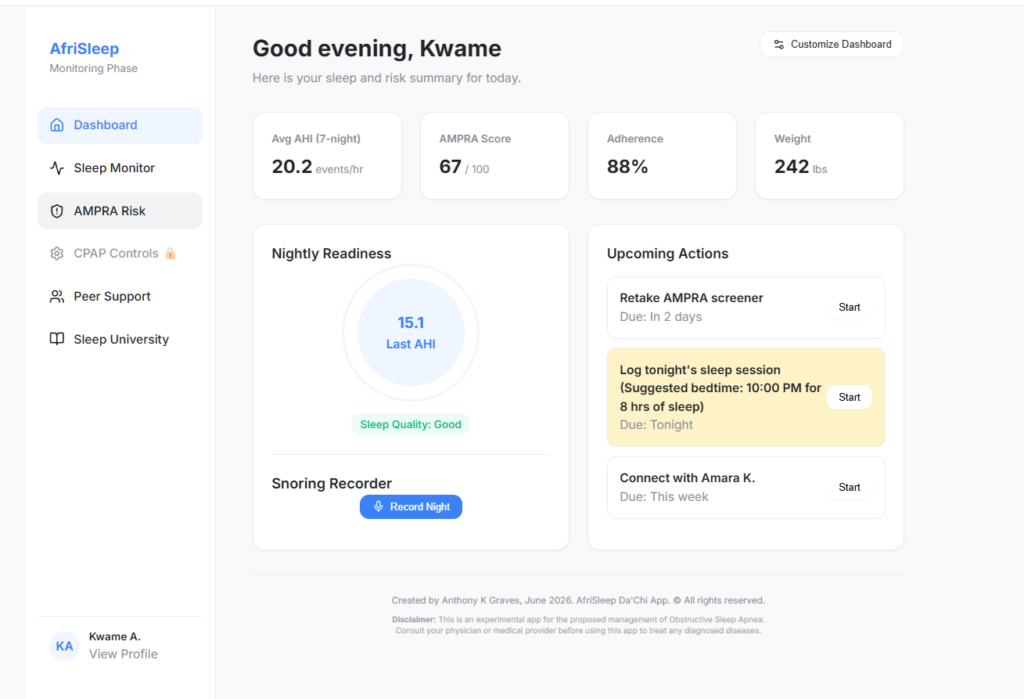
Dashboard View
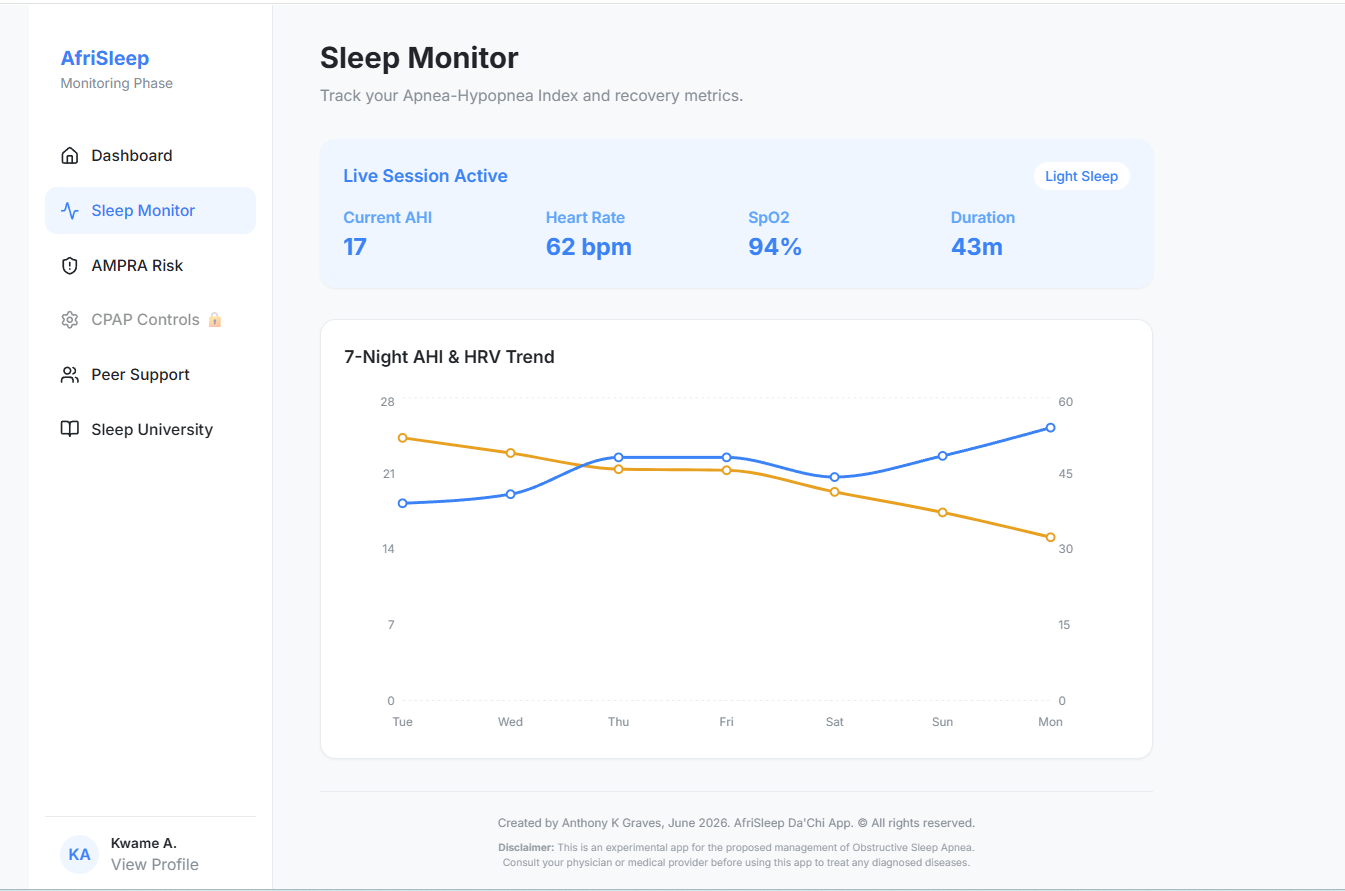
Sleep Monitor View
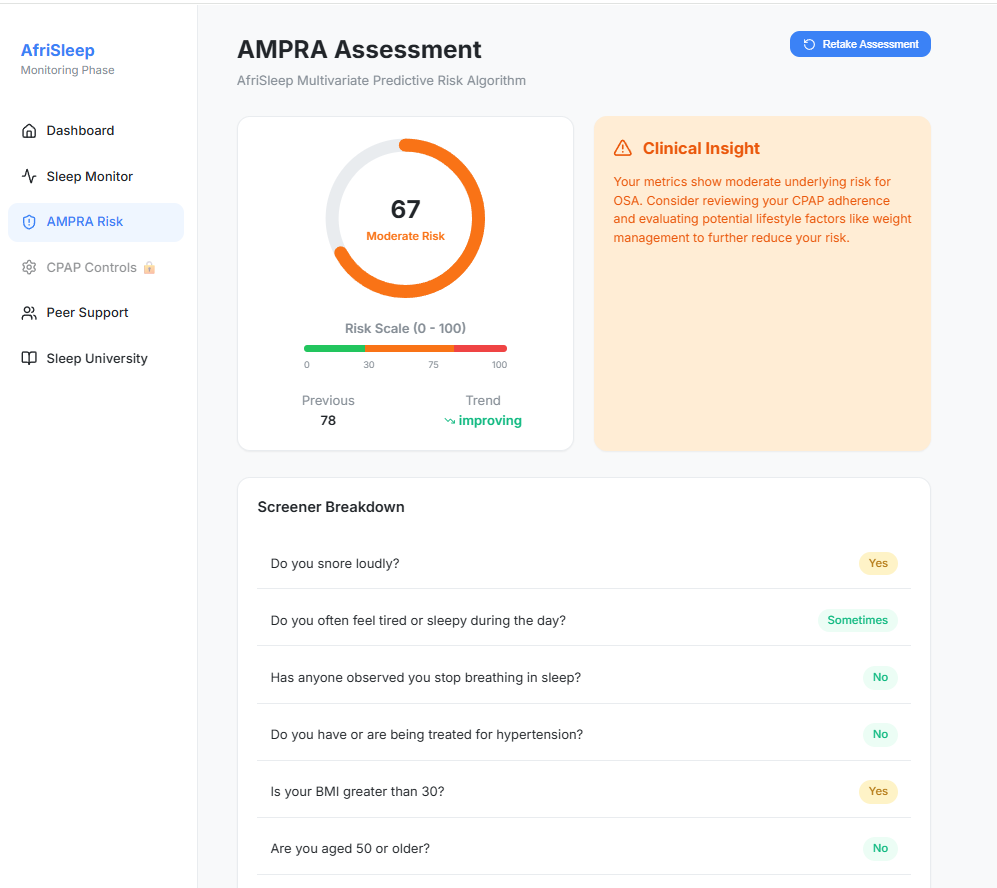
AMPRA Risk Assessment View
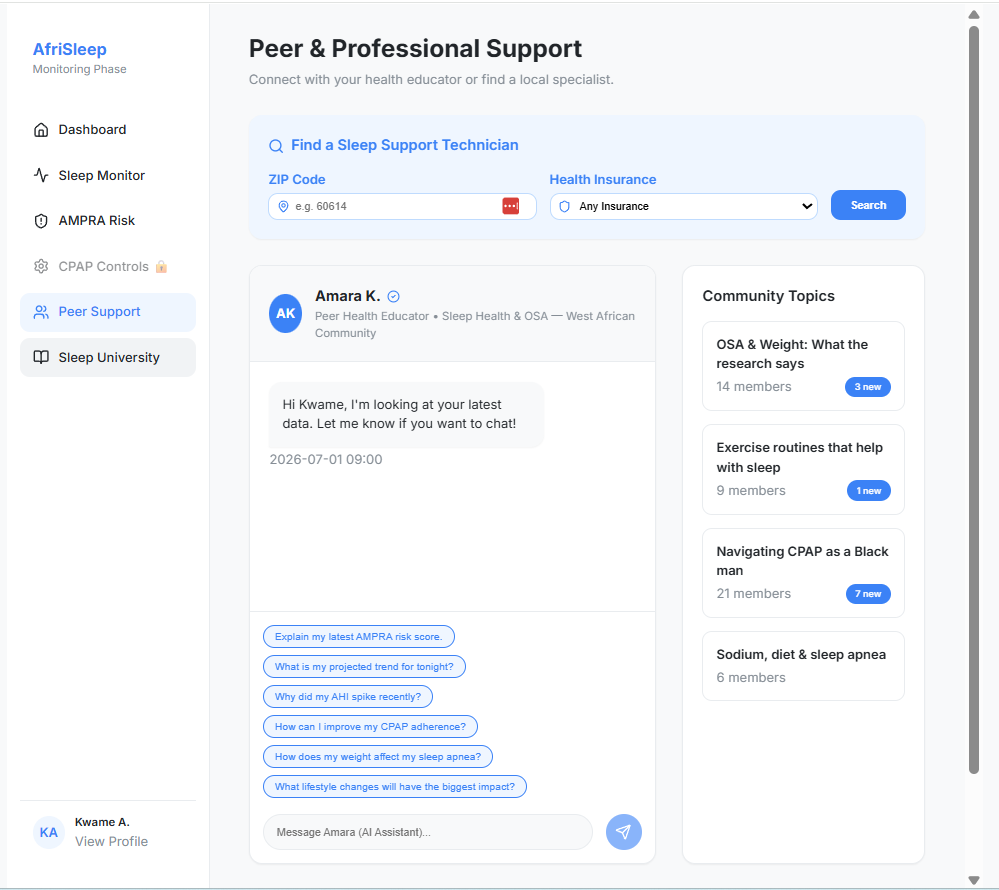
Peer and Professional Support View
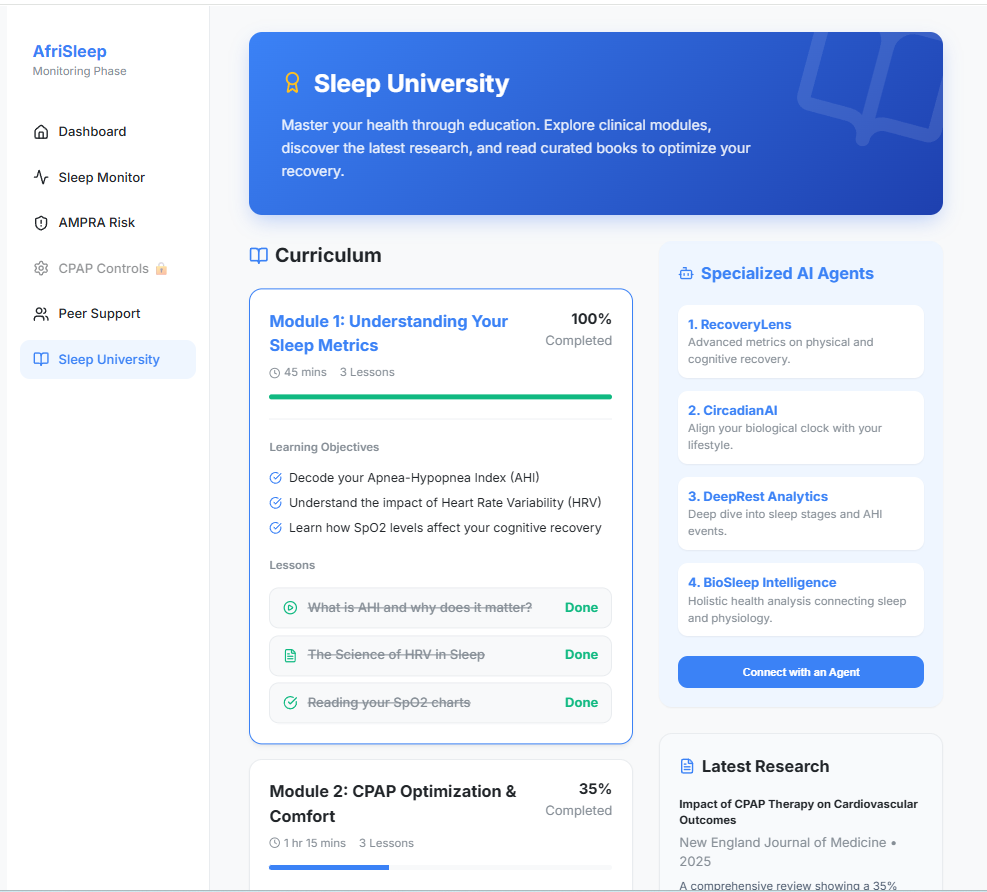
Sleep University and Specialized AI Agents View
Conclusion
The development of AfriSleep Da’Chi demonstrates that modern AI development platforms have significantly lowered the barrier to building sophisticated healthcare applications in a remarkably short period of time. What began as a five-day learning exercise evolved into a proof of concept for a next-generation sleep intelligence platform—one that extends well beyond traditional sleep apnea monitoring.
Rather than viewing Obstructive Sleep Apnea as an isolated condition, AfriSleep Da’Chi embraces a holistic perspective that recognizes the interconnected relationships between sleep quality, cardiovascular health, physical activity, nutrition, mental well-being, and long-term recovery. By integrating data from CPAP therapy, wearable devices, wellness applications, and evidence-based clinical research, the platform shifts from simply reporting historical events to understanding why those events occur and how they can be prevented.
The long-term vision is to transition from descriptive health analytics to predictive and prescriptive intelligence. Future iterations of the platform will correlate physiological, behavioral, and environmental data to identify patterns that may precede poor sleep, elevated cardiovascular stress, reduced recovery, or declining health. As machine learning models mature, AfriSleep Da’Chi can evolve into a personalized digital health companion capable of forecasting health risks, recommending evidence-based interventions, and supporting proactive conversations between patients and healthcare providers.
The roadmap reflects this progression through four strategic phases: integrating health data into a unified analytics platform, applying machine learning to uncover causal relationships, developing predictive models capable of forecasting health events before symptoms emerge, and ultimately delivering precision sleep medicine through continuously personalized recommendations. Beyond these phases lies the opportunity to create a dynamic digital twin that models an individual’s sleep, recovery, cardiovascular health, and overall wellness over time.
Equally important is the platform’s commitment to addressing a meaningful healthcare disparity. Existing commercial sleep technologies largely focus on generalized populations, while AfriSleep Da’Chi is intentionally designed with the needs of African and African American men in mind—a population that experiences a disproportionate burden of obstructive sleep apnea yet remains underdiagnosed and undertreated. By combining culturally relevant education, peer-supported engagement, AI-driven coaching, and longitudinal health analytics, the platform seeks not only to improve treatment adherence but also to build trust, encourage early intervention, and promote healthier outcomes within underserved communities.
Ultimately, AfriSleep Da’Chi represents more than a software application. It is an exploration of how agentic AI, clinical research, wearable technologies, and responsible data integration can converge to create a new model for personalized healthcare. While the current prototype validates the technical architecture and user experience, the next chapter will focus on clinical validation, expanded device integrations, explainable AI, regulatory readiness, and population-scale analytics. The destination is clear: an intelligent, culturally aware precision health platform that empowers individuals to move beyond managing sleep apnea toward optimizing recovery, resilience, and lifelong wellness.
view a youtube short of the application in action:
Follow the Kaggle Submission here:
https://kaggle.com/competitions/vibecoding-agents-capstone-project/writeups/dachi-app-implementing-effective-intervention-f
References
National Heart, Lung, and Blood Institute. “Jackson Heart Study, Largest Investigation of Heart Disease in African Americans, Promises to Pave Way for Precision Medicine.” National Institutes of Health. December 14, 2017. https://www.nhlbi.nih.gov/news/2017/jackson-heart-study-largest-investigation-heart-disease-african-americans-promises-pave.
National Heart, Lung, and Blood Institute. “Study: Sleep Apnea Common, Largely Undiagnosed in African Americans.” National Institutes of Health. September 6, 2018. https://www.nhlbi.nih.gov/news/2018/study-sleep-apnea-common-largely-undiagnosed-african-americans.
United Press International. “Sleep Apnea Often Missed in Black Americans, Study Says.” September 7, 2018. https://www.upi.com/Health_News/2018/09/07/Sleep-apnea-often-missed-in-black-Americans-study-says/4371536341845/?sl=1.