“The enterprises that master these three areas will define the next generation of AI-enabled infrastructure.”
I stepped away from my screens for a networking invitational at the friendly and kind behest of my colleagues at BDI. (Shout out to Steve E.!)
The social event was well attended by AI Practitioners and Engineers from startups and established enterprises from Finance, Health, Gaming and Cloud Infrastructure.
The topic of On-Premises Infrastructure was the topic at hand. How do we invest in a robust cloud infrastructure at scale when IP and intellectual property is at risk?
The challenges inherent are evident in the following sub topics: (in no particular order of importance stay with me for a moment while I unpack my ideas)
a. Token Economics —> AI Resource Governance
b. Context Compaction —> Scaling Intelligence Efficiently
c. Model Routers —> The AI Control Plane
d.The Emerging Enterprise AI Stack
Token Economics
A major and current challenge beginning to emerge in the AI adoption landscape is Token Economics. AI workloads are computationally expensive. Without governance, organizations will quickly experience runaway GPU consumption, unpredictable costs, and resource contention.
Token economics introduces a framework for usage accountability, compute budgeting, inference prioritization and sustainable AI consumption. In enterprise environments, “tokens” evolve beyond concepts and become expensive resource units: GPU units, inference quotas, vector retrieval costs, memory utilization and model execution budgets.
Organizations that operationalize token-aware AI systems will be able to:
1.prioritize mission-critical workloads
2.optimize compute allocation
3.measure AI ROI
4.Enforce policy-driven AI consumption.
This becomes especially important in shared infrastructure where multiple business units compete for finite AI resources.
Context Compaction
One of the least discussed but most important problems in enterprise AI is context explosion. Imagine a large Healthcare operation dealing with PII across domains ranging from Addiction Medicine, Psychiatry, Brain Injury medicine to Vascular Neurology. The scale and context is vast! Large AI systems accumulate chat history, retrieval results, logs, workflow states, memory chains and agent interactions.
Without optimization, context windows become bloated, expensive and slower over time. Context compaction solves this problem by reducing information while preserving semantic meaning.
Examples include:
1.Summarization pipelines
2.Semantic memory distillation
3.Vector compression
4.Hierarchical memory structures
5.and stat extraction
The result:
Lower inference costs, reduced latency, improved retrieval accuracy and better long-running AI performance.
This becomes essential for AI copilots, autonomous agents, RAG systems and enterprise knowledge orchestration.
Model Routers –> The AI Control Plane
As enterprises move towards multi-model architectures, a single LLM strategy becomes financially and operationally unsustainable.
Different workloads require different models:
+ lightweight models for summarization
+domain-tuned models for compliance
+code generation models for engineering and architecture
+secure isolated models for sensitive workloads
This is where model routers become critical. A model router acts as an intelligent orchestration layer that dynamically routes requests based on:
</>Python
if request.type == “code”:
route_to(“CodeLlama”)
elif request.type == “finance”:
route_to(“Finetuned-Mistral”)
# workload complexity
# GPU availability
# latency
#governance policies
#security boundaries
#cost optimization
In practice, this means simple requests use low-cost inference, complex reasoning escalates to larger models, sensitive workloads remain air-gapped on-prem, GPU clusters are balanced dynamically.
This transforms an enterprise AI architecture from static into an adaptive infrastructure service.
The Emerging Enterprise AI Stack
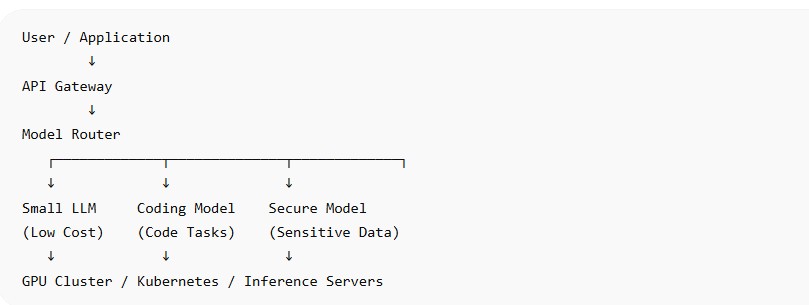
This is no longer just “prompt engineering.”
This is distributed systems engineering for AI operations.
Final Thoughts
Organizations that succeed with AI at scale will not simply deploy models. They will build operational intelligence platforms capable of:
+ routing intelligence efficiently
+governing compute economically
+managing context intelligently
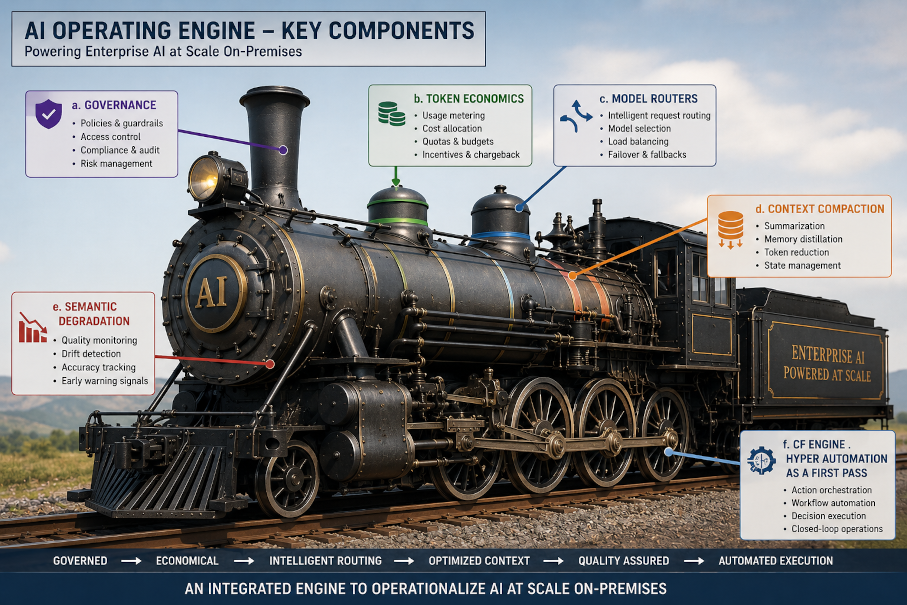
image showing a locomotive and AI descriptive tags
Title Image Credit: HPE’s Kelsey Neilsen

Tony Graves, M.Ed. interacting with event participant.

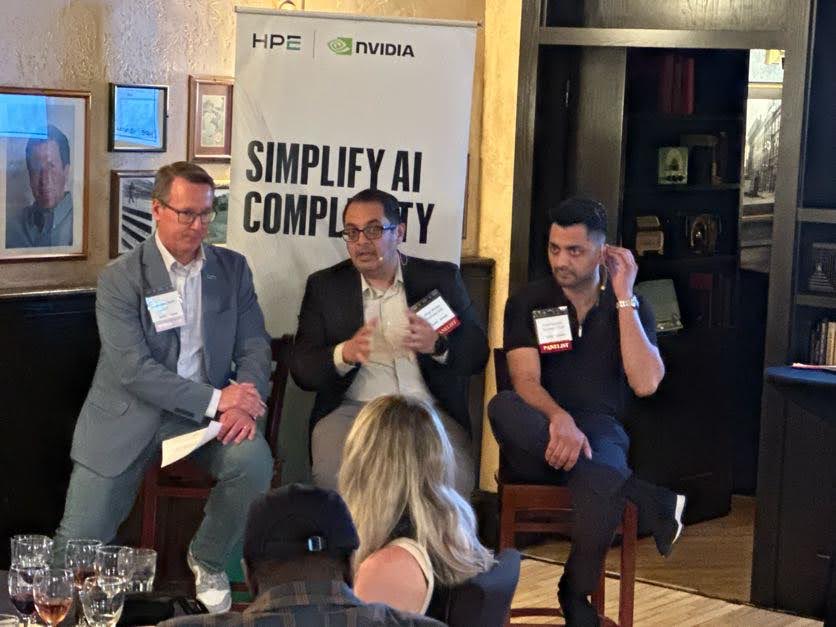
Panelist row with Andrew Goade, HPE