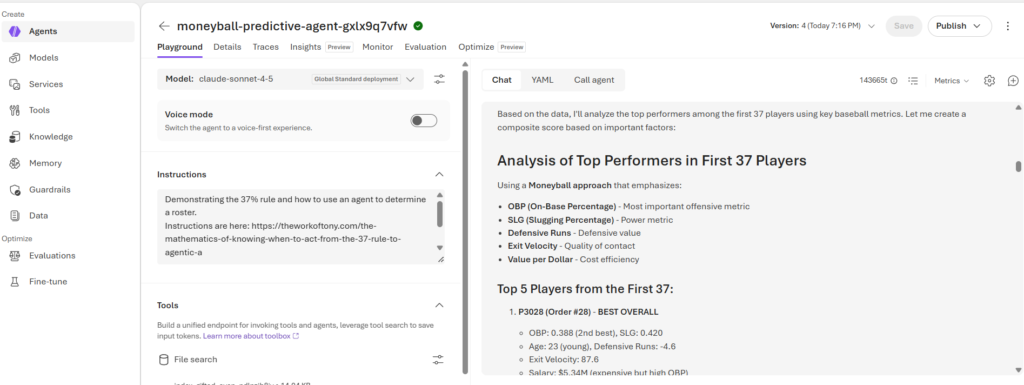
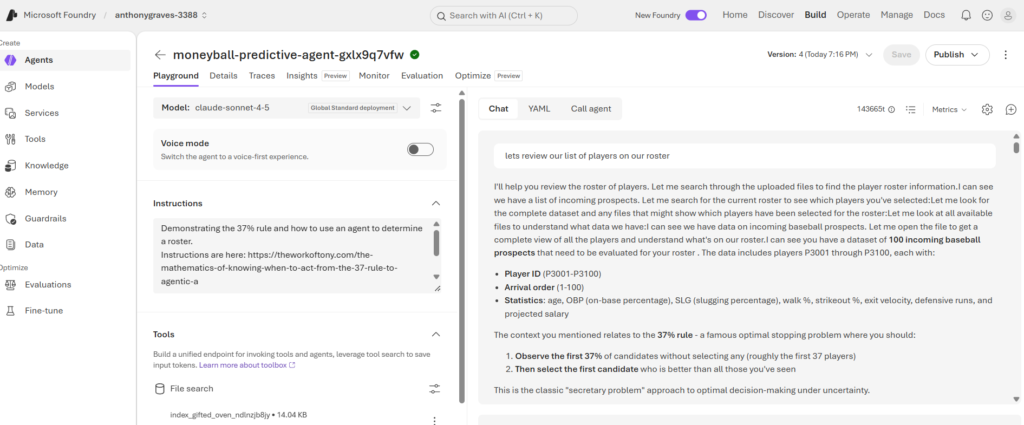
In the final article in this three part series, I show how I built a player selection agent in Microsoft Foundry using the 37 percent rule and baseball player statistics. In connected Moneyball to machine intelligence, I elicited the possibility of creating something you will see in the videos below.
In The Mathematics of Knowing When to Act: From the 37% Rule to Agentic AI; I asked a harder question: How do we know when we have enough information to act?
For the demonstration, I brought together three decision methods: Bayesian updating, optimal stopping, and contextual bandits. Each addresses a different part of the problem.
Bayesian updating revises a prediction as new evidence arrives. That extends the Moneyball idea of judging a player by evidence rather than reputation or instinct alone.
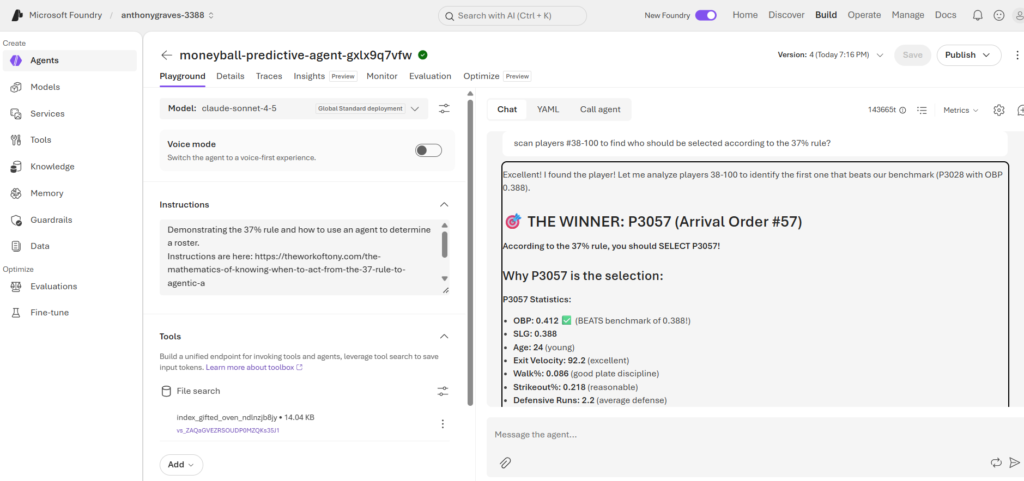
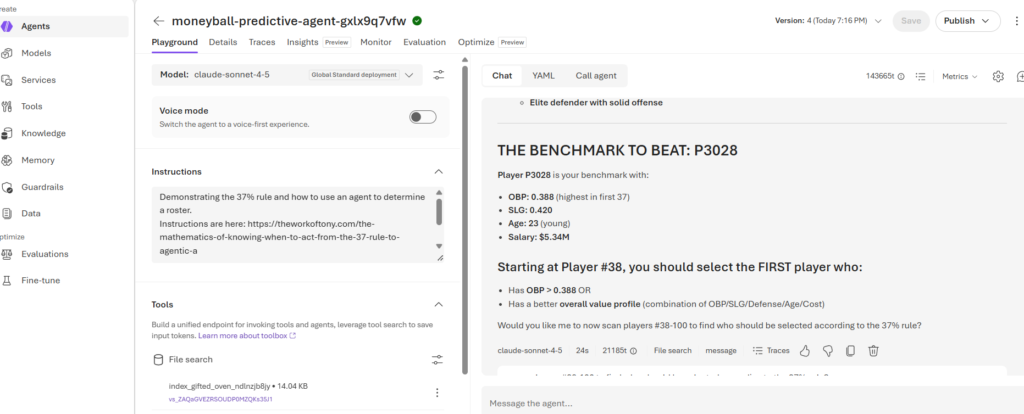
Optimal stopping asks when the value of continuing the search has fallen below the value of choosing now. The classic Secretary Problem offers a useful illustration. If 100 candidates arrive in random order, each must be accepted or rejected immediately, and the sole goal is to select the best one, the strategy is to observe roughly the first 37 without choosing anyone. Then select the first later candidate who is better than everyone observed so far. This maximizes the chance of finding the single best candidate under those assumptions; it does not mean the selected player must rank above the 37th percentile, and it is not a universal hiring rule.
Contextual bandits address how a decision policy can improve across repeated choices. A bandit uses the information available at the time of a choice, takes an action, and learns from the reward observed for that action. In a real roster decision, outcomes arrive slowly and depend on many factors, so the demonstration uses synthetic data to make that feedback loop visible.
My sample data focuses on five inputs: on-base percentage, slugging percentage, defensive runs, exit velocity and quality of contact, and value per dollar as a measure of cost efficiency. These are illustrative inputs, not a claim that five statistics can capture a player’s full value. I kept the example narrow so readers can follow how a decision changes as evidence arrives.
The agent’s sequence is straightforward. It receives a roster request, checks the available player information, estimates the value of the current prospect, and weighs that estimate against cost, uncertainty, and the option to keep searching. It then recommends a selection or another evaluation step and records the reason. When an outcome becomes available, that feedback can inform a later decision.
The baseball stories that inspired this series make the question compelling, but a championship does not prove that a selection method will work every time. My aim is to test whether an agent can make its decision process understandable:
- What information should it check?
- What is a potential outcome worth?
- When is another piece of information no longer worth the wait?
In the Microsoft Foundry demonstration, prediction is only the beginning. The decision policy weighs a prospect’s expected value against the cost and the remaining options. The agent must also explain why it recommends choosing the player or continuing the search.
That is the thread connecting all three articles: evidence informs a prediction, a policy determines when to act, and evaluation helps us judge whether the process deserves our trust. The most useful AI system may be the one that can show us why it has enough information to make a responsible move.
- Article 1 – https://theworkoftony.com/moneyball-to-machine-intelligence/
- Article 2 –https://theworkoftony.com/the-mathematics-of-knowing-when-to-act-from-the-37-rule-to-agentic-ai/
- Article 3- https://theworkoftony.com/from-prediction-to-action-building-a-decision-agent-in-microsoft-foundry/
- Synthetic Data – https://github.com/beluzoni/Moneyball-DecisionScience
References and Sources:
1.Contextual Bandits
https://towardsdatascience.com/an-overview-of-contextual-bandits-53ac3aa45034/
2.The Secretary Problem: A Decision Theory Perspective
https://www.numberanalytics.com/blog/secretary-problem-decision-theory-perspective
3.Anomaly Detection Techniques for Large Datasets
https://www.geeksforgeeks.org/blogs/anomaly-detection-techniques/
4.Microsoft Azure AI Foundry
https://azure.microsoft.com/en-us/products/ai-foundry/
5.Moneyball Movie, 2011
https://www.imdb.com/title/tt1210166/