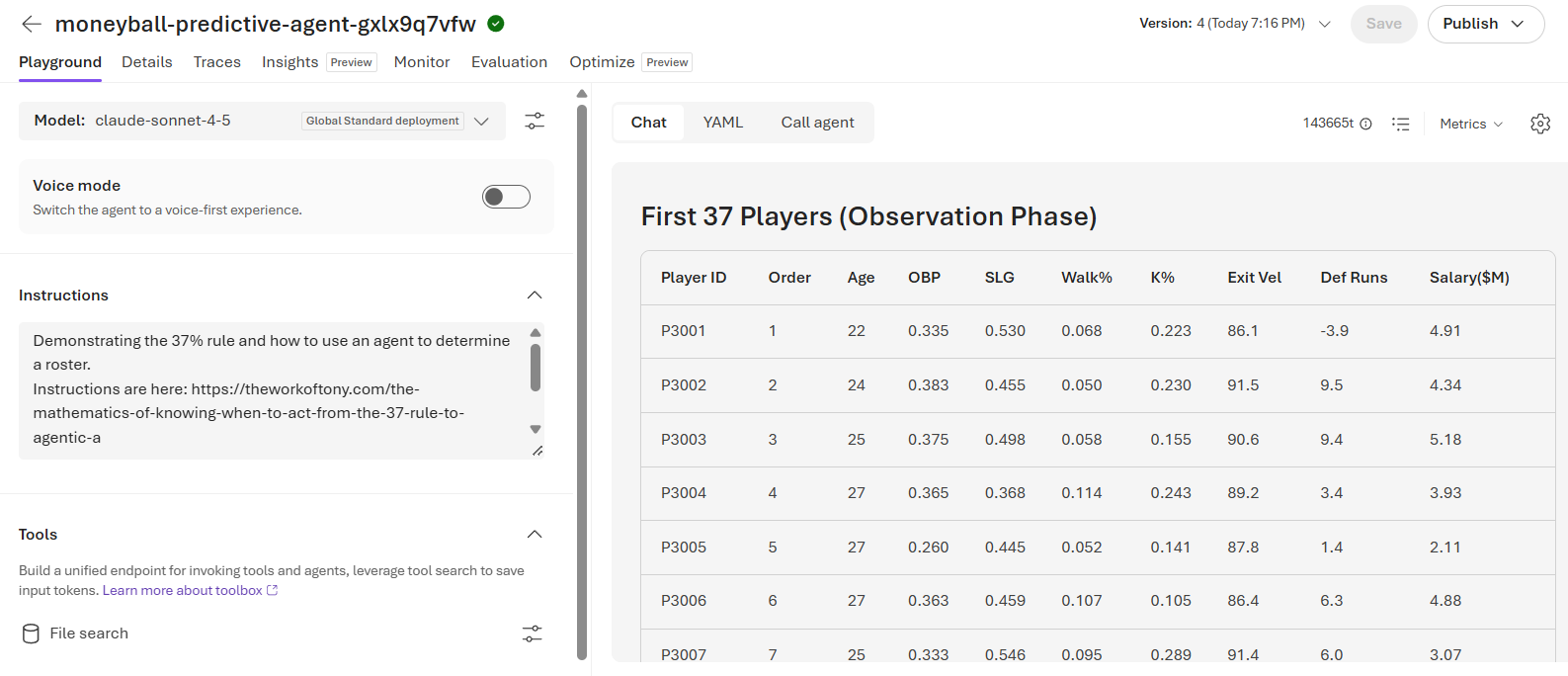
Professional sports might be one of the best ways to understand where enterprise AI is headed.
Long before we started talking about AI agents, machine learning, Gemini Enterprise, or predictive analytics, sports teams were already asking a very similar question:
How do we take all this information and turn it into a better decision than our competitor?
Baseball helped introduce the idea. Formula 1 has taken it to another level.
And now AI is bringing the same thinking into the enterprise.
The interesting part isn’t just having more data. Companies have had mountains of data for years.
Lets start with the Boston Red Sox.
The story actually gets more interesting if we start with 2012 instead of their 2013 World Series championship.
The 2012 Red Sox were bad. They finished last in the American League East.
Then Boston did something interesting.
They started changing the system.
Boston had already become one of baseball’s early adopters of analytics under Theo Epstein. Statistics increasingly worked alongside traditional scouting, player evaluation and human judgement.
Then in 2013 the Red Sox went from worst to first and won the World Series.
Analytics didn’t win the World Series.
Players did.
But better information helped people make better decisions about which players to acquire, how to construct the roster and how to compete.
Then Theo Epstein Took the Experiment to Chicago
Theo Epstein eventually left Boston and joined the Chicago Cubs.
When he arrived in Chicago in 2011, the Cubs hadn’t won the World Series since 1908.
Think about that problem from an AI perspective.
The question wasn’t simply:
“How do we find better baseball players?”
It was closer to:
“How do we build a system that consistently identifies, develops and combines players in ways that increases our probability of winning?”
That is a much more interesting problem.
The Cubs accumulated young talent. They developed prospects. They used analytics. They made strategic trades. They combined statistics with scouting and human judgement.
Then in 2016, the Cubs won the World Series.
A 108-year drought was over.
It wasn’t AI.
But look at the process:
Data → Analysis → Human Judgment → Decision → Action → Results → New Data.
Sound familiar?
We would probably call some version of that an agentic workflow today.
Now Put the Race Car on the Track
Formula 1 takes this idea and turns the speed dial all the way up.
Baseball sometimes gives you days to make a decision.
Formula 1 might give you seconds.
A modern F1 car is basically a very fast computer with wheels.
Sensors are constantly producing telemetry about the car, tires, driver, track, temperature and performance.
McLaren has described generating more than a terabyte of data during a race and running close to 300 million race simulations before a race weekend.
Why?
Because the team is constantly asking questions.
What happens if the tires degrade faster than expected?
What happens if it rains?
What happens if our competitor pits?
What happens if a safety car comes out?
Should we pit now?
That’s where data becomes prediction.
And prediction becomes strategy.
But the computer doesn’t drive the strategy by itself.
Engineers, drivers and race strategists still make the decisions.
That relationship between machine intelligence and human judgement is exactly how I think about enterprise AI. That Machine is called Google Gemini Enterprise.
So What Does This Have to Do With Gemini Enterprise?
Imagine replacing Formula 1 telemetry with your company’s information.
Contracts.
Sales records.
Customer history.
Policies.
Financial information.
Support tickets.
Research.
Marketing data.
BigQuery datasets.
Most organizations already have enormous amounts of information.
The problem is figuring out what to do with it.
This is where the three layers of Gemini Enterprise starts to make alot more sense.
Gemini Enterprise App:
“What do we know?”
The Gemini Enterprise app retrieves and reasons over documents and knowledge bases.
Maybe I ask:
“Find our policies related to this customer situation and summarize them.”
Great.
But eventually I want more.
“Find the policies, compare them against the customer’s situation, identify the exceptions and determine what should happen next.”
Now I’m starting to feel friction.
Retrieval isn’t enough anymore.
And that’s the point.
Agent Designer:
Now I need orchestration.
Agent Designer lets us build multi-step workflows combining retrieval with structured logic.
Think about the baseball manager.
Knowing a batter struggles against left-handed pitching is information.
Deciding whether to change pitchers based on that information, the inning, score, bullpen availability and who’s batting next is a workflow.
Now our AI process looks more like:
Retrieve → Analyze → Compare → Apply Rules → Recommend
That’s significantly more powerful.
But eventually I hit another wall.
What happens when the answer isn’t inside a document?
What happens when it has to be calculated?
Or predicted?
There’s the friction again.
Agent Development Kit:
The Agent Development Kit (ADK) opens the door to much deeper development.
Now developers can programmatically connect agents with data platforms such as BigQuery and machine learning models.
Go back to Formula 1.
The basic question might be:
“What happened during the last 20 races?”
That’s retrieval.
But the more interesting question is:
“Based on historical races, current conditions, tire degradation and competitor behavior, what is likely to happen during the next 15 laps?”
That’s prediction.
But there is still one more question.
“What should we do about it?”
Now we’re moving beyond chatbots.
We’re talking about decision intelligence.
The Friction Is the Point
This is probably the biggest lesson I took away from looking at the Gemini Enterprise architecture.
Don’t think about these as simply three different AI tools.
Think about them as levels.
Gemini Enterprise App
What do we know?
Agent Designer
What process should we execute?
ADK + BigQuery + Machine Learning
What is likely to happen next, and what can we do about it?
Every time the question becomes more complicated, you start feeling the limitations of the layer you’re currently using.
That friction is the point.
It tells you your problem has become more sophisticated than your current tool.
Baseball spent decades learning that intuition becomes much more powerful when paired with information.
Boston showed what happens when analytics, scouting and human judgement come together.
Chicago showed how systematic decision-making could help end a 108-year championship drought.
Formula 1 takes the same idea and accelerates it to milliseconds.
And enterprise AI is bringing this capability into organizations.
I think the first generation of generative AI was mostly about asking machines questions.
And maybe thats the bigger story behind Gemini Enterprise.
The goal isn’t to remove the strategist, engineer, analyst or executive.
It’s to give them a better intelligence system.
Because whether you’re trying to win the World Series, win a Grand Prix, or outperform a competitor, the question is pretty much the same:
Can you turn information into the right decision faster than everybody else?
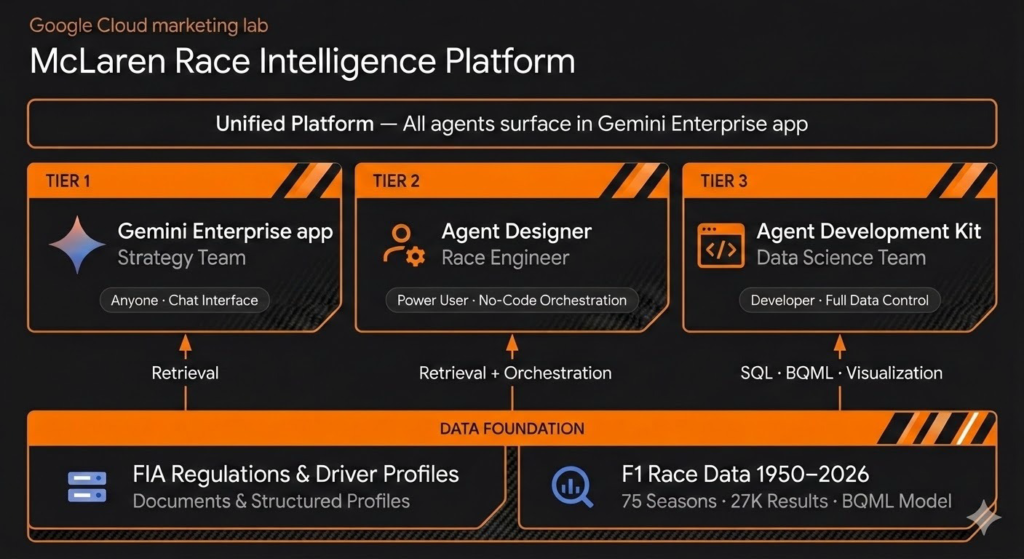
Image courtesy of Google Cloud Marketing Lab and McLaren Racing Platform
Sources:
1.McLaren’s Intelligent Platform – https://rescale.com/resources/mclaren-automotive-operationalizing-ai-physics-agentic-engineering/
2.Boston Red Sox 2013 World Series – https://www.baseball-reference.com/postseason/2013_WS.shtml
3.Gemini Enterprise App – https://cloud.google.com/gemini-enterprise
4.Google Cloud Skills – https://cloud.google.com/learn/training